

Build a Business That Supports the Life You Want.
A prosperous business is not just about making more sales. It should solve a real problem, serve the right people, produce reliable profit, and give you greater control over your time and future.
Use this page to strengthen the foundations of your business, attract customers more consistently, improve the way you work, and make better growth decisions.

Start With the Area Holding Your Business Back
Choose a business challenge below to jump to a free, practical lesson on this page. Each lesson includes a short explanation, an example, and an exercise you can complete. Use the Business Action Workbook to record your answers and build your 30-day plan.
Start With a Clear Offer
Define the problem you solve, the result you provide, who you help, and why someone should choose you.
Attract Better Customers
Create a simple marketing system that helps the right people discover, understand, and trust your business.
Improve Profit and Cash Flow
Price with confidence, control unnecessary costs, understand margins, and make decisions based on real numbers.
Build Better Systems
Reduce repeated work, organize important tasks, document processes, and use tools that save time without adding complexity.
Create an Offer People Can Understand and Value
A strong business starts with a clear answer to four questions: Who do you help? What problem do you solve? What result do you provide? Why should someone trust you?

Make It Easy for Customers to Say, “This Is for Me.”
Many businesses struggle because the message is too broad, the offer is confusing, or the customer cannot quickly see the value.
Focus on one clear customer, one important problem, one useful result, and one simple next step. Clarity makes marketing, sales, pricing, and delivery easier.
Know Your Customer
Identify the people who have the problem, value the result, and are most likely to take action.
Solve a Specific Problem
Avoid vague promises. Describe the frustration, cost, delay, risk, or missed opportunity you help reduce.
Explain the Result
Show what becomes easier, faster, safer, clearer, or more profitable after using your product or service.
Build a Simple Path From Attention to Trust to Action
Marketing works best when it guides people through a clear sequence. First, they discover you. Then they understand what you offer. Next, they see evidence that you can help. Finally, they know what action to take.
You do not need to be everywhere. Choose a few channels you can use consistently and connect them to a useful offer.
Create Useful Content
Answer real questions, explain common mistakes, demonstrate expertise, and help potential customers make better decisions.
Make the Next Step Obvious
Every page, email, post, or video should lead toward one clear action such as learning more, joining a list, requesting help, or making a purchase.
Use Proof and Trust Signals
Include testimonials, examples, experience, guarantees, clear policies, useful reviews, and honest explanations of who the offer is for.
Follow Up Consistently
Many customers need time. Use email, helpful reminders, and valuable content to stay useful without becoming pushy.
Build a Business That Produces More Than Revenue
Revenue can look impressive while a business still struggles. Sustainable growth requires healthy pricing, controlled costs, dependable cash flow, and a clear understanding of what is actually profitable.
Price for Sustainability
Include the real cost of your time, tools, delivery, support, taxes, fees, and future growth—not just what competitors charge.
Track the Numbers That Matter
Know your revenue, expenses, profit, cash available, average sale, customer acquisition cost, and highest-value offers.
Reduce Low-Value Work
Identify tasks, services, customers, or products that consume time without producing enough value or profit.
Build Financial Reserves
Create room for taxes, emergencies, slower periods, equipment, marketing, and opportunities without relying on constant borrowing.
Make the Business Easier to Run
A business becomes difficult to grow when every task depends on memory, constant decisions, or the owner doing everything manually.
Document Repeated Tasks
Turn important recurring work into simple checklists, templates, and step-by-step procedures.
Use the Right Technology
Choose tools for websites, communication, scheduling, payments, customer management, automation, and reporting based on actual needs.
Automate Carefully
Automate repetitive, predictable tasks while keeping human review for customer relationships, important decisions, and quality control.
Protect Your Time
Set boundaries, organize priorities, group similar work, and stop allowing low-value tasks to consume the best hours of the day.
Before You Add Another Tool, Product, or Strategy
Business owners are constantly offered new platforms, tactics, courses, and opportunities. Use this filter before committing money or time.
Ask These Five Questions
1. What exact problem will this solve?
2. Is this problem important enough to solve now?
3. What will it cost in money, time, setup, and maintenance?
4. How will I measure whether it worked?
5. What will I stop doing to make room for it?
Use Practical Resources to Make Better Decisions
Explore tools, training, reviews, and guidance selected to help small businesses solve real problems without unnecessary complexity.
Business Tools
Explore platforms for websites, payments, marketing, communication, productivity, customer management, and operations.
Trusted Reviews
Understand what a product does, who it is for, its strengths, its limitations, and whether it offers meaningful value.
AI for Small Business
Use AI for content, research, planning, customer communication, workflows, and productivity while keeping human judgment involved.
Coaching and Training
Get structured guidance when you need help clarifying priorities, building a plan, or moving through a specific business challenge. This training is Part 5 of our Business Action Training and worksheet ready for download.

Business Action Training
Work through five practical lessons to clarify your offer, plan your marketing, understand your business numbers, improve a process, and create a 30-day action plan. Complete the exercises in a notebook or use the free Business Action Workbook below.
Lesson 1 — Clarify Your Offer and Audience
Start with a specific customer, a problem they recognize, and a result you can realistically help them work toward. Write the answers in a notebook or the Business Action Workbook.
Choose the customer and problem
- Describe one type of customer and the situation they are in.
- Write the problem in the words that customer would use.
- Explain what the problem costs them in time, effort, or frustration.
- Ask a potential customer which part of the problem matters most.
Draft your offer statement
I help [customer] work toward [specific result] through [product or service]. They receive [deliverable], with [scope or limits].
Example: I help local service businesses organize customer inquiries through a simple intake form and follow-up checklist. They receive a working form and written handover instructions.
Finish with an action: ask one relevant person what is clear and what needs explaining.
Lesson 2 — Plan Your Marketing and Follow-Up
Choose a channel you can use consistently and one action you want an interested person to take. Keep the plan specific enough to try and review.
Map the path to an inquiry
- Where could the right customer discover you?
- What useful question can your content answer?
- What example or demonstration can help them assess your work?
- What is the next action, such as requesting information or viewing an offer?
Plan one week of activity
Choose one useful piece of content, one place to share it, and one follow-up task for people who have asked to hear from you.
Record: the action, date, time spent, relevant inquiries, and what you learned. Review those observations before repeating or expanding the activity.
Example: Answer a common customer question in a short post, share it in an appropriate channel, and respond to resulting inquiries.
Lesson 3 — Understand Your Costs and Cash Flow
Use your own records to list costs, payments received, and upcoming commitments. These worksheets help organize information for planning and discussion with your bookkeeper or accountant.
List the inputs behind a price
- Record the deliverable and the time needed to produce it.
- List direct materials, tools, delivery costs, and transaction fees.
- List ongoing expenses and how you currently account for them.
- Note assumptions, missing information, and questions to verify.
Separate one-time costs from ongoing expenses. Review estimates against actual costs after completing the work.
Map the next four weeks
- Start with cash available for the business.
- List expected payments and when you expect to receive them.
- List bills and other payments due in each week.
- Mark uncertain amounts and dates so you can follow up.
Planning estimate: opening cash plus expected receipts minus expected payments. Compare the estimate with what actually happens.
For further guidance, see the SBA guide to business costs and managing business finances.
Lesson 4 — Build Better Operations and Systems
Choose a task that comes up regularly, such as responding to an inquiry, preparing an invoice, or delivering a completed project. Document how it should work before adding automation.
Write a simple operating checklist
- Trigger: what starts the task?
- Owner: who is responsible?
- Inputs: what information or materials are needed?
- Steps: what happens, in order?
- Completion: how do you know the work is correct and finished?
Test and simplify the process
Run the checklist on one real example. Note missing information, repeated work, delays, and steps requiring judgment.
Choose one improvement. If considering automation, identify what it should do, what needs human review, and how a failed step would be noticed.
Example: inquiry received, details checked, response prepared, next action recorded, responsible person notified.
Lesson 5 — Assess Your Business and Create a 30-Day Plan
Use this guided self-assessment when you need to choose a priority. Write down the issue, consider what you know, and turn one decision into a small experiment.
Clarify the challenge
- What is happening, and what evidence supports that description?
- What would a useful improvement look like?
- What have you tried, and what happened?
- What information or skill is missing?
- Whose feedback could help you make the next decision?
Choose your next 30 days
- Week 1: clarify the issue and gather missing information.
- Week 2: try one manageable change.
- Week 3: review observations and adjust.
- Week 4: decide what to continue, change, or stop.
Record the task, owner, date, time or cost limit, and review measure. Use the workbook to prepare for a conversation with an adviser if you need more help.
SUPPORTING RESOURCE
Get the Free Business Training & Workbook
Put your business action plan on paper. Use seven practical worksheets to clarify your offer, plan marketing, review business numbers and cash flow, strengthen systems, and build a 30-day action plan.
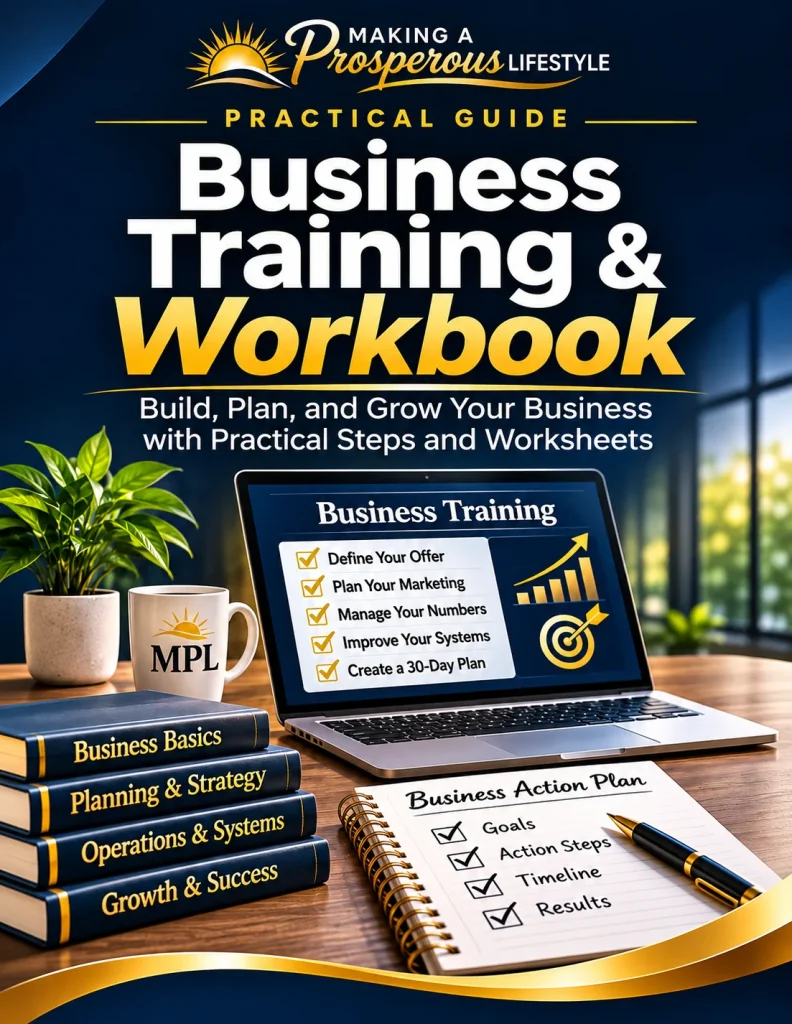
Get Your Free Business Workbook
Complete the form below and we will email your free Business Training & Workbook download link. You can continue reading the online training without signing up.
Print it or fill it in on your device. Save a copy to keep your answers.
Solve One Important Problem First
Choose the area creating the most friction right now—your offer, customer growth, profit, or operations. Focus on one useful improvement and build from there.