

Build a personal growth plan in 7 days
Build a personal growth plan by choosing one meaningful goal and turning it into a small action you can repeat. Use this seven-day guide to build a routine, practice a useful skill, and review what helped. The free fillable workbook gives you a place to write down your plan and track your progress.
One focus. One small action.
Finish this sentence: This week, I want to make progress on…
- Choose one area you can influence.
- Pick an action small enough for a busy day.
- Decide when you will do it.
- Review what helped at the end of the week.
What is personal growth, and how does it help you build a more prosperous lifestyle?
Personal growth is the process of building habits, skills, and confidence that help you make better everyday decisions. It supports a more prosperous lifestyle by helping you focus on what matters, use your time more deliberately, and develop skills that can improve your work and daily life.
Start with one area you want to improve this week:
- Set a clear goal. Choose one result you can work toward and describe what progress would look like.
- Build a repeatable habit. Attach one small action to a routine you already follow.
- Protect time for what matters. Schedule a short block for your priority and remove one distraction.
- Practice a useful skill. Apply what you learn to a real task, then use the result to decide what to try next.
START WITH WHAT MATTERS
What would you like to improve first?
You do not need to change everything at once. Choose the area that would make the biggest practical difference right now.
Find a clearer direction
Turn a broad intention into one specific outcome and a next step you can schedule.
Create a routine you can repeat
Connect a small action to something you already do, with a simpler version for difficult days.
Use your time with intention
Choose a priority, reduce one distraction, and give an important task a clear place in your day.
Grow through practice
Build confidence by practicing a useful skill, asking for feedback, and noticing what you learn.
DIRECTION
Turn a good intention into a workable goal.
A useful goal tells you what you want to do, why it matters, and what the next action looks like.
Write down four answers
- Outcome: What would you like to complete or improve?
- Reason: Why is this worth your attention now?
- Next action: What can you do without waiting for a perfect plan?
- Review date: When will you check your progress?
Make it specific
Broad intention: I want to learn something new.
Workable plan: I will spend 15 minutes learning a spreadsheet skill on Tuesday and Thursday, then use it in one small example by Sunday.
Choose a goal that fits your available time and circumstances. Adjust the scope when needed.
CONSISTENCY
Make the routine easier to begin.
Design a starting point you can use even when time or motivation is limited.
Attach an action to a cue
After I [existing routine], I will [small action] in [place].
Example: After I make my morning drink, I will write down my most important task at the kitchen table.
Prepare what you need in advance so starting requires fewer decisions.
Plan for imperfect days
- Choose a minimum version: one paragraph, one practice question, or two minutes of preparation.
- Make a simple note when you complete the action.
- If you miss a day, return at the next useful opportunity.
- Change the routine if it repeatedly conflicts with your real schedule.
TIME AND ATTENTION
Give your priority a place in the day.
Try one focused work block
- Name the task and what finishing this session would look like.
- Choose a realistic block of time, even if it is only 10 minutes.
- Close unrelated tabs and put avoidable notifications aside.
- Write down the next step before you stop.
Decide what can wait
Ask: What am I agreeing to that leaves no room for my priority?
Postpone, simplify, or decline one low-priority commitment where you can. Keep room for responsibilities, rest, and time with people who matter to you.
A useful schedule supports your life; it does not need to account for every minute.
SKILLS AND CONFIDENCE
Build experience through small attempts.
Pick something you want to become more capable at: presenting an idea, using a tool, writing clearly, or handling a useful everyday task.
Keep the practice concrete
- Choose one skill rather than a whole subject.
- Find one lesson, example, or instruction you can work through.
- Practice on a small task with manageable consequences.
- Ask someone you trust for specific, useful feedback.
Reflect without keeping score
After an attempt, ask: What worked? What was difficult? What will I try differently?
Keep a short record of completed tasks and lessons learned. Use it to choose your next practice step rather than compare your pace with someone else.
PUT IT INTO PRACTICE
Your simple weekly reset.
Use a notebook or a notes app. Set aside a few minutes to complete these prompts.
Choose and schedule
- My focus this week: one thing that matters.
- My smallest useful action: a step I can repeat.
- When and where: a realistic place in my week.
Notice and adjust
- What I completed: progress worth noticing.
- What got in the way: a practical obstacle.
- What I will change: one adjustment for next week.
Choose one exercise from this page and try it for a week. Keep what helps, simplify what does not, and decide your next step from what you learn.
SUPPORTING RESOURCE
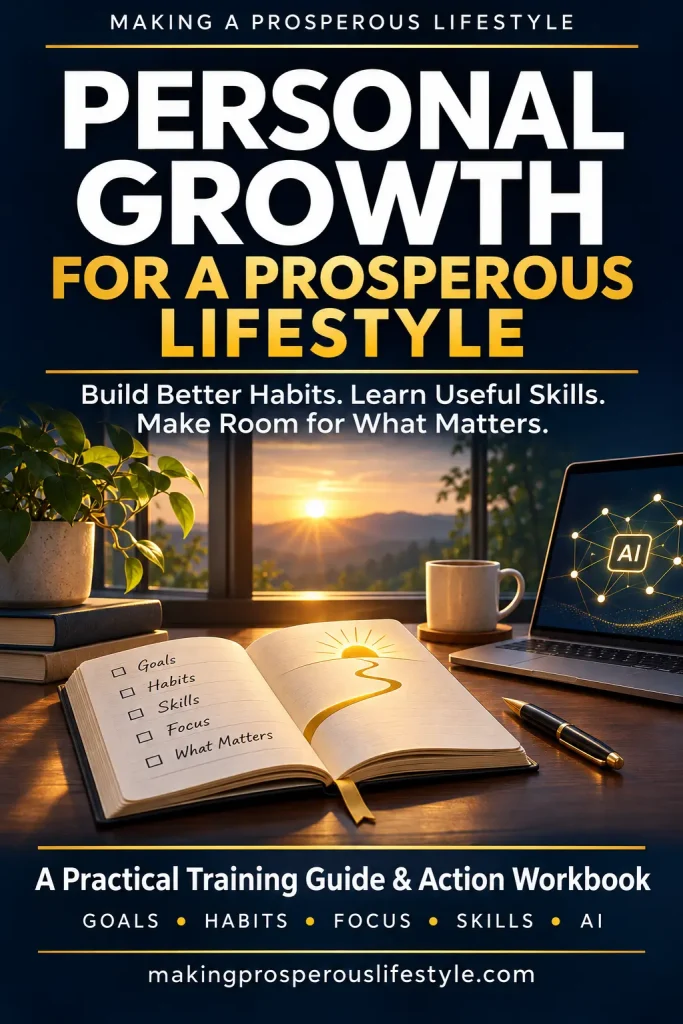
Get the Free Personal Growth Training & Workbook
Build better habits, set meaningful goals, strengthen useful skills, and discover practical ways to use AI. This free 29-page training guide connects the MPL resources and includes a fillable 7-Day Personal Growth Workbook to help you put your learning into action.
Get Your Free Personal Growth Guide
Complete the form below and we will email your free Personal Growth Training & Workbook download link. You can continue reading the online training without signing up.
Print it or fill it in on your device. Save a copy to keep your answers.
Personal Growth FAQs
How do I start a personal growth plan?
Choose one area you want to improve, pick an action you can finish in 5–15 minutes, and decide when you’ll do it. For example, schedule two short spreadsheet practice sessions and use one new skill to build a simple weekly budget.
How can I stay consistent when life gets busy?
Create a smaller version of the habit for busy days. If your usual plan is to practice for 15 minutes, your minimum might be completing one exercise. When you miss a day, pick up at the next scheduled opportunity.
How can I tell if I’m making progress?
At the end of the week, review what you did, what got in the way, and what you’ll adjust. Look for a concrete change, such as finishing a task more easily or using a skill you practiced.
Can AI help me with personal growth?
Yes. AI can help you break a goal into steps, suggest practice exercises, or turn your notes into a weekly checklist. For example, ask it to build a seven-day practice plan around 10 minutes a day. Review the plan and adapt it to your real schedule.
For more ways to use AI for planning and learning, explore our AI & Technology guides.
What’s included in the free Personal Growth Training & Workbook?
The free 29-page guide covers goals, habits, skills, and practical ways to use AI. It includes a fillable 7-Day Personal Growth Workbook you can print or complete on your device. Use the signup form to receive the download link by email.
KEEP EXPLORING
Connect personal growth with everyday action.
Use the other areas of MPL when you need a practical tool, a clearer starting point, or a new way to organize your work.
Work with useful tools
Explore how AI and technology can support planning, learning, and everyday productivity.
Choose your next direction
Find the MPL area that matches what you want to work on next.