

Tax season for the 2025 calendar year is set to begin earlier than in recent years. The Internal Revenue Service announced a firm start date for processing returns, and new federal tax provisions passed in recent legislation will affect many taxpayers. This article outlines the key dates and explains the new breaks that may reduce taxable income for seniors, certain vehicle buyers, tipped workers, and overtime earners. It also reviews a new savings option for children and practical steps to claim these benefits.
Short and to the point.
When the IRS Will Start Accepting 2025 Returns
The IRS confirmed that it will begin accepting 2025 federal income tax returns on Monday, January 26. That start date marks one of the earliest filing opens in a decade. Treasury leadership highlighted the intent to move refunds and tax benefits into taxpayers’ hands as soon as systems are ready to process returns.
Because many tax preparation services and software platforms coordinate their release schedules with the IRS, January 26 is the earliest date that electronic filing and official submissions can be made. Paper returns typically follow the same opening, though processing times for mailed forms remain longer.
If you plan to file as soon as possible, confirm that your software or tax preparer is prepared for that date and that you have gathered all necessary documentation before submitting.
Overview of New Tax Breaks in 2025
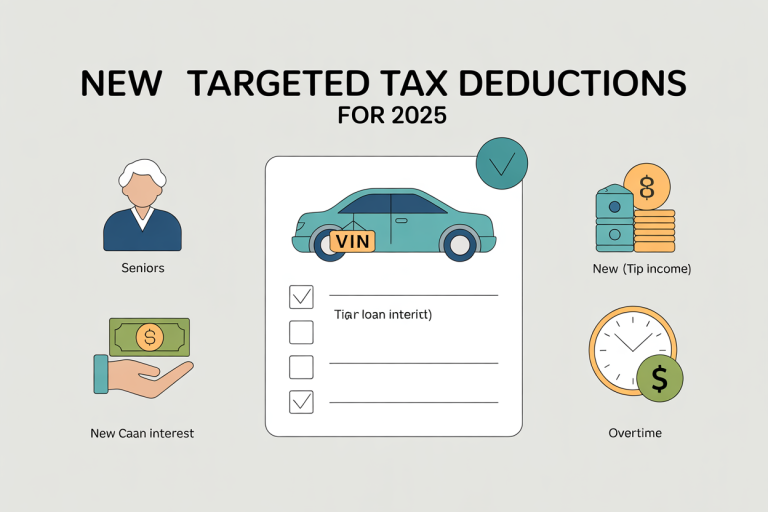
The One Big Beautiful Bill Act introduced several targeted deductions that will be available beginning with 2025 tax returns. Legislators designed these provisions to reduce taxable income for specific groups and types of income. The main changes include:
– An enhanced deduction for seniors tied to Social Security income.
– An interest deduction for new car loans that meet specific assembly requirements.
– A deduction for reported tip income for workers who customarily receive tips.
– A deduction for overtime pay, with different limits depending on filing status.
Some of these provisions are temporary and include phaseouts based on modified adjusted gross income. Others require reporting details on the tax return, such as the vehicle identification number for the auto loan interest deduction.
Enhanced Deduction for Seniors
One of the most discussed items is an additional deduction aimed at individuals with Social Security income. The law provides an enhanced deduction of $6,000 for eligible seniors. That amount is in addition to the standard deduction you may already claim.
The enhanced deduction phases out for single taxpayers with modified adjusted gross income (MAGI) above $75,000 and for joint filers with MAGI above $150,000. The provision is designated as temporary and applies for tax years 2025 through 2028.
For retirees, this deduction can reduce taxable income and potentially lower overall tax liability. It is most beneficial for those whose incomes fall beneath the phaseout thresholds and who already receive taxable Social Security benefits.
Deduction for New Car Loan Interest
A new item allows a deduction for interest paid on loans for new vehicles, with a cap of $10,000 in qualifying interest. There are several conditions to meet.
First, the vehicle must be new and have final assembly in the United States. The National Highway Traffic Safety Administration’s VIN Decoder can be used to confirm where final assembly occurred. Taxpayers must list the vehicle identification number (VIN) on their returns to claim the deduction.
Second, the deduction applies only to interest on loans for eligible new cars; it does not cover used vehicles. Income phaseouts also apply, meaning higher earners may see the benefit reduced or eliminated.
Keep careful records of the loan agreement, interest paid, and the VIN to ensure a smooth claim when filing.
Deduction for Tip Income
Workers who regularly receive gratuities have a new opportunity to reduce taxable income. The law allows a deduction of up to $25,000 for tip income for those who normally and regularly receive tips as part of their job.
A few rules accompany this break. The tip income must be reported to qualify for the deduction. Reporting remains necessary for Social Security and Medicare tax purposes, which are separate from the income tax deduction. In other words, even if tip income is deductible under this provision, the associated payroll taxes generally still apply.
This deduction is aimed at service industry employees and others reliant on tips, but it requires accurate reporting and documentation.
Deduction for Overtime Pay
Overtime compensation can also receive preferential treatment. Single taxpayers may qualify for a deduction on up to $12,500 of overtime pay, while married taxpayers filing jointly can claim a deduction up to $25,000.
Income thresholds determine phaseout: single filers whose income exceeds $50,000, and joint filers with income over $300,000, will begin to see the overtime deduction reduced. The precise computation follows the tax code’s phaseout formulas.
For many workers who regularly earn overtime, this deduction can lower taxable income and possibly reduce marginal tax rates. Maintain payroll records, employer statements, and any documentation that confirms overtime hours and pay rates.
Trump Accounts for Children

A new savings option, commonly referred to as Trump accounts, functions similarly to a specialized individual retirement arrangement for minor children. While it will not be effective in 2025 for new contributions, eligible parents can elect to enroll an eligible child on their 2025 tax return.
To participate, taxpayers file Form 4547 with their Form 1040 when submitting a 2025 return if they have a child born between January 1, 2025, and December 31, 2028. Eligible children selected for the program will receive a $1,000 credit from the U.S. Treasury as part of initial enrollment.
Taxpayers considering this option should review eligibility rules and account limitations, and ensure Form 4547 is completed accurately when filing.
Filing Deadlines and Extensions
The standard deadline for submitting 2025 individual tax returns is Wednesday, April 15. Taxpayers who cannot file by that date may request an automatic extension by timely submitting Form 4868, which generally extends the filing deadline to October 15.
An extension to file does not extend the time to pay any taxes owed. Tax payments should be estimated and paid by the April deadline to avoid penalties and interest. If you expect a refund, filing later will delay receipt.
Plan ahead for both filing and payment. Missing the filing deadline without an extension or failing to meet payment obligations can lead to penalties that compound over time.
How to Prepare to Claim New Breaks
Start by gathering the documentation tied to each potential deduction. For seniors, keep records of Social Security benefits and any Medicare-related documents that affect taxable amounts. For car loan interest, retain loan statements, the vehicle’s VIN, and proof of final assembly if needed.
If you receive tips, maintain accurate daily or shift-level logs and copies of any employer tip reports. For overtime deductions, obtain detailed pay stubs or employer certifications that show overtime totals separately from regular pay.
Software packages and tax preparers will begin updating their systems for the January 26 filing open date. Confirm that your chosen tax software includes fields for the new deductions and that it supports Form 4547 if you intend to enroll a child in a Trump account.
Practical filing steps
– Verify eligibility thresholds before claiming breaks.
– Keep original documents for at least three years.
– Enter VIN and loan details carefully to avoid processing delays.
Common Issues and What to Watch For
New tax provisions often create administrative and reporting challenges during the first filing season. Expect questions from filers about income phaseouts and how deductions interact with other credits and exclusions. Mistakes on VIN entries or omitted supporting information may trigger IRS notices or delays in processing refunds.
Reporting requirements for tips are strict. Failure to report tip income accurately can disqualify the deduction and raise payroll tax liabilities. Likewise, overclaiming overtime deductions without clear payroll evidence may prompt audits.
If your income places you near phaseout thresholds, run multiple scenarios or consult a tax professional to determine the best approach. Keep an eye on IRS guidance and updates, since the agency typically issues instructions and worksheets tied to new legislative provisions.
Final Thoughts
The early IRS filing date and the set of new deductions introduced for 2025 present opportunities to reduce taxable income for several groups of taxpayers. Seniors, buyers of qualifying new vehicles, tipped workers, and those who earn overtime may benefit, provided they meet the eligibility and reporting rules. Parents of children born in the specified window can opt into the new savings account by filing the appropriate form with their 2025 return.
Careful documentation and attention to phaseout limits will help ensure accurate claims. Prepare records now and verify that your tax software or preparer is ready for the January 26 filing open date to make the most of these changes.
Stay Up To Date with the latest News, Blog Posts, Tips and Training...