

Affiliate Marketing for Beginners: Your Guide to Getting Started
Affiliate marketing is a referral-based way to earn commissions by recommending another company’s products or services. You share an assigned tracking link and may earn a commission when someone completes a qualifying purchase or approved action. Learn how to evaluate products, choose programs, create useful content, and check your results.
This is a beginner’s working guide. Outcomes depend on the audience, product, content, traffic, and program terms. Reading the guide or joining a network does not guarantee earnings.

What Is Affiliate Marketing?
Affiliate marketing is a way to earn money online by promoting products or services offered by other companies. When someone clicks your unique affiliate link and completes a qualifying purchase or action, you earn a commission based on the advertiser’s program terms.
You don’t need to create your own products or manage inventory. Instead, you help people discover useful products and services through blogs, websites, product reviews, videos, email marketing, and social media.
How affiliate marketing works
Affiliate marketing means referring people to another business through a tracking link. If a purchase or other action qualifies under that program’s rules, you may earn a commission. Joining a program does not guarantee approval for every product, a sale, or payment.
- Choose a reader and a problem you understand.
- Evaluate a relevant product and its affiliate terms.
- Obtain approval where required and generate your assigned link.
- Publish helpful content with a clear disclosure.
- Check recorded activity, approved commissions, and actual payouts.
The seller normally handles its checkout and product delivery. You remain responsible for the accuracy of your own content and following the program’s promotion rules.
YOUR STARTING WORKFLOW
How to Start Affiliate Marketing: Six Practical Steps
These six steps take you from choosing a reader’s problem to publishing and reviewing a useful recommendation. Follow them in order for one product and one piece of content, then repeat the process when you evaluate another offer.
Your goal is to help someone make an informed decision. The steps below show what to research, what to create, what to check, and how to learn from the result.
Prefer a workbook you can keep? Get the free 25-page Affiliate Marketing Field Guide with a 30-day action plan and four printable worksheets. Use the signup form to receive the download link by email.
1. Start with a reader’s problem
Choose a narrow question you can answer well, such as comparing two scheduling tools for a solo service business. Your job is to help the reader make a suitable decision, including deciding not to buy.
- Who is the reader and what are they trying to accomplish?
- What are their budget, skill, and time constraints?
- Which features matter to this use case?
- What could they do with tools they already own?
Exercise: Write three real questions your audience asks. Select one where you can provide useful evidence, examples, or a demonstration.
2. Evaluate the product before the commission
Read current documentation, examine the actual offer, and test the product when possible. Record what you personally tested separately from what the vendor states.
- What is included in the specific version or plan?
- What are the ongoing costs, add-ons, limits, and renewal terms?
- Who will benefit, and who should choose something else?
- What support, cancellation, or refund terms does the seller publish?
- Does the product solve the reader’s problem well enough to recommend?
Do not imply hands-on experience you do not have. If your assessment relies on documentation, say so. A large commission does not make a weak product useful.
3. Read the program’s terms and get approved
Some businesses run direct programs; others use affiliate networks or marketplaces. Check eligibility, product approval, permitted traffic sources, attribution rules, payment schedules, thresholds, refund adjustments, and account requirements before promoting.
Look specifically for rules on email, paid advertising, bidding on brand names, using logos, coupons, link shortening, and offering bonuses. Terms differ between programs and can change.
Generate your link from the approved account dashboard. A normal vendor URL does not become an affiliate link just because you applied. Keep an internal record of the program, approval, product, assigned URL, and date you last reviewed the terms.
4. Build a useful guide, review, or comparison
Keep the reader’s decision at the center. Explain what the product does, show a realistic use case, describe limitations, and connect claims to evidence.
- State the problem and who the content is for.
- Explain your research or testing method.
- Show what is included and the work involved.
- Discuss strengths, drawbacks, and alternatives.
- Explain who should consider it and who should skip it.
- Offer an optional next step to the seller’s current details.
Worked example: For a scheduling-tool comparison, define a solo consultant’s needs, test creating an appointment type if you have access, record supported calendar connections, compare the relevant plans, and explain remaining gaps. Do not invent a successful customer story to fill missing evidence.
5. Explain the relationship where readers will see it
Make financial or other material relationships clear alongside the recommendation. A footer policy alone may be missed. The FTC’s official guidance explains placement, clear wording, and disclosure in different formats; read it for your channel and situation.
Example disclosure to adapt: “I may earn a commission if you purchase through the affiliate links on this page.”
Use wording that accurately describes your relationship. If you received a free review copy or another benefit, disclose that as appropriate too. Do not promise that the price is unchanged unless you have confirmed it.
In video, include the disclosure within the video rather than relying only on its description. A platform’s disclosure label can supplement a clear explanation. Check program requirements and applicable rules for your audience and channel.
6. Test the link and review the results
Use the program’s approved link-testing method. Confirm that a click reaches the intended product or plan and that your link has been copied accurately. Do not make a self-purchase to test commissions unless the program explicitly permits it.
- Record the content page, product, link, and promotion channel.
- Distinguish visits, clicks, attributed transactions, approved commissions, and paid commissions.
- Account for reversals, fees, content costs, and advertising costs when reviewing results.
- Check for broken links, changed offers, and outdated claims periodically.
If you use email, send through permitted channels to an appropriate opted-in audience and follow the relevant rules. Avoid posting promotional links where they are unwanted or prohibited.
When changing an ordinary source link to an approved affiliate link, update the disclosure at the same time. Keep purely informational references as ordinary links where appropriate.
PUT THE WORKFLOW INTO PRACTICE
Your First Week: Turn the Steps Into Action
Use this seven-day practice plan to apply the six-step workflow to one useful comparison, review, or tutorial. Each day gives you a manageable task so you can move from research to a first draft, then check your work before sharing it.
Treat the week as a flexible practice schedule. Give yourself more time when research, testing, or program approval requires it. Success here means producing a helpful, checked piece of content and learning what to improve next.
A seven-day plan for your first useful page
- Day 1: Choose one reader and one buying question.
- Day 2: Shortlist relevant products and compare their actual terms.
- Day 3: Research or test the strongest candidate and record evidence.
- Day 4: Apply to the appropriate program and document its rules.
- Day 5: Draft a guide or comparison with strengths, limits, and alternatives.
- Day 6: Verify claims and add approved links and disclosures when available.
- Day 7: Publish after review, share through a permitted channel, and record a baseline.
If approval is pending, publish useful factual content with ordinary source links where appropriate. Do not describe an unapproved link as commission-earning. Return to the page after approval.
SUPPORTING RESOURCE
Get Your Free Affiliate Marketing Field Guide
Not sure where to start? Get the 25-page Affiliate Marketing Field Guide and turn what you’ve learned into a practical plan—with five affiliate platforms to explore, content and traffic strategies, a 30-day action plan, and four printable worksheets.
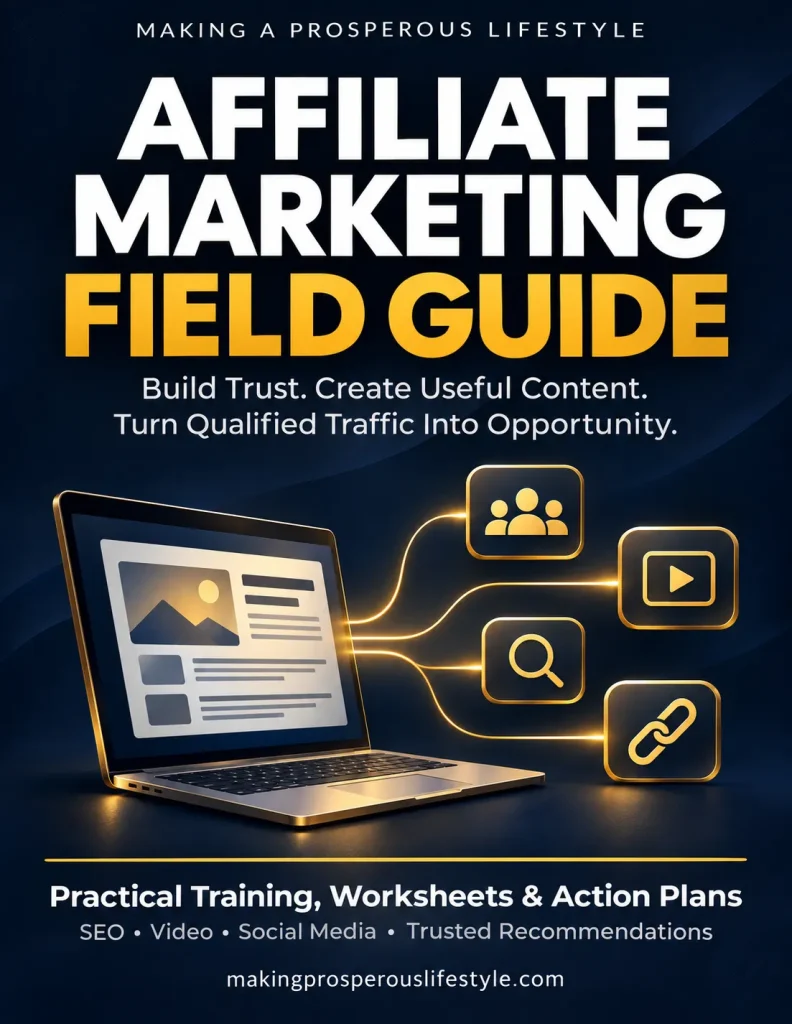
Get Your Free Affiliate Marketing Guide
Enter your first name and email address to receive the free 25-page Field Guide. You can continue reading the online training without signing up.
We will email your download link. Unsubscribe anytime.
Official resources to explore
These sources help you check current requirements. They open in a new tab. A marketplace listing or program approval is not proof of product quality; evaluate each offer independently.
FTC disclosure guidance
Read the FTC’s guidance on disclosing material relationships alongside endorsements and recommendations.
ClickBank affiliate information
Explore the official affiliate overview and support resources. Review account requirements, product terms, tracking, and payment conditions before promoting an offer.
JVZoo affiliate information
WarriorPlus affiliate information
Impact brand partnerships
Awin brand partnerships
Explore Awin’s platform for publishers, bloggers, and creators seeking affiliate partnerships. Review advertiser opportunities, commission details, promotional methods, and application requirements to find programs that align with your niche and audience.
These are ordinary informational links. MPL does not earn a referral commission from these links.
Before your first promotion
- The product fits a real question your audience has.
- Your claims match evidence and your actual experience.
- You have reviewed relevant program rules and obtained required approval.
- The assigned link points to the correct offer.
- Material relationships are disclosed clearly where relevant.
- The page covers limitations and alternatives as well as benefits.
- Your promotion channel permits the content.
- You can distinguish pending results from actual payouts.
Your next action: Outline one comparison or tutorial that would help a reader even if they decide not to purchase.
COMMON QUESTIONS
Affiliate Marketing Questions, Answered
Use these answers to clear up common questions before you choose a program or prepare your first recommendation.
What is affiliate marketing for beginners?
Affiliate marketing means referring people to a product or service using an assigned tracking link. You may earn a commission when an eligible action is recorded and approved under the program’s rules. A useful starting point is one reader question, one relevant product, and an honest explanation.
Do I need a website to start affiliate marketing?
Not every program requires a website. Some accept other established publishing channels, while others have specific website, audience, or content requirements. Check the current rules before applying or placing links. Choose a channel you can maintain and use to help readers make a decision.
How do I choose my first affiliate program?
Start with a product that fits a problem your audience actually has. Compare its usefulness, evidence, price, limitations, approval requirements, permitted promotion methods, tracking terms, and payout rules. Choose based on fit and trust rather than commission rate alone.
Can I promote a product before affiliate approval?
You can prepare useful content while waiting. If you publish it, use ordinary source links where appropriate and do not present an unapproved link as commission-earning. Add assigned affiliate links only when you have the required approval and have checked the program’s rules.
What should my first piece of affiliate content include?
Answer a specific question. Explain what the product does, who it may suit, how it could be used, and its limitations or alternatives. Distinguish what you tested from information you researched. Check your claims and relevant relationships before adding an appropriate next step.
How long does affiliate marketing take to produce income?
There is no guaranteed timeline or income. Results depend on the audience, product fit, useful content, traffic, program approval, and eligible customer actions. The seven-day plan on this page is a practice schedule for creating content, not a promise of earnings.
Can AI help me create affiliate marketing content?
AI can help organize notes, suggest reader questions, and review a draft for gaps. Check the final facts against reliable sources and your own testing. Do not let AI invent experience, results, testimonials, prices, or product features.
What is included in the free Affiliate Marketing Field Guide?
The 25-page guide covers affiliate platforms, SEO, video, social media, a 30-day action plan, and four printable worksheets. Use the signup form above to receive the download link. The online training remains available without signing up.